Train Addiction Help Line: 1.866.840.7777
Oct 3, 2016 - O Scale
MTH - RailKing Freight Cars (Case Quantity) - Tank Car - O Scale 3 Rail
MTH - RailKing Freight Cars (Case Quantity) - Tank Car - O Scale 3 Rail

 Gondola Car w/Cover
On its customer Web site, the Union Pacific Railroad characterizes a gondola as an "extremely sturdy open design" for carrying "rugged unfinished commodities"; its "large flat interior design with side walls" is described as "more flexible than a flat car." These qualities make the modern gondola particularly popular with the steel industry, for transportation of loose materials like scrap metal, waste, coke, and slag as well as finished products like iron or steel plate, pipe, structural steel, and rails for railroad track. Other commodities commonly shipped in these versatile cars include mineral ores, granite slabs, gravel, logs, lumber, railroad ties, and even prefabricated railroad track, also known as "panel track."
Gondola Car w/Junk Load
On its customer Web site, the Union Pacific Railroad characterizes a gondola as an "extremely sturdy open design" for carrying "rugged unfinished commodities"; its "large flat interior design with side walls" is described as "more flexible than a flat car." These qualities make the modern gondola particularly popular with the steel industry, for transportation of loose materials like scrap metal, waste, coke, and slag as well as finished products like iron or steel plate, pipe, structural steel, and rails for railroad track. Other commodities commonly shipped in these versatile cars include mineral ores, granite slabs, gravel, logs, lumber, railroad ties, large crates, and even prefabricated railroad track, also known as "panel track."
Modern Tank Car
The tank car was relatively uncommon until the 1870s, when the nascent petroleum industry ordered large quantities of metal tanks carried on wooden car bodies. By the early 1900s, a standard design had evolved that lasted throughout the steam and early diesel eras: an 8,000-11,000 gallon metal tank perched on a metal flatcar-like underframe.
Tank Car
The tank car was relatively uncommon until the 1870s, when the nascent petroleum industry ordered large quantities of metal tanks carried on wooden car bodies. By the early 1900s, a standard design had evolved that lasted throughout the steam and early diesel eras: an 8,000-11,000 gallon metal tank perched on a metal flatcar-like underframe.
The one big change during that time was the transition from riveted to welded construction beginning in the late 1930s. Car builders introduced X-ray inspection of welds to ensure safety, as well as giant annealing ovens that could heat-treat assembled tanks to relieve joint stress. Welded tanks were stronger, less susceptible to rust and corrosion, and less likely to rupture in the event of a wreck.
Our model represents a typical all-welded, insulated tank car built in the late 1940s or 1950s. A layer of insulation protected cargos that were sensitive to temperature extremes, and some such cars also had heating coils under their outer layer. Our model also features a safety platform around the dome - insulation and safety platforms being features commonly found on cars used in the chemical industry.
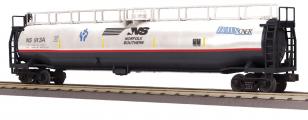
33K Gallon Tank Car
The tank car was relatively uncommon until the 1870s, when the nascent petroleum industry ordered large quantities of metal tanks carried on wooden car bodies. By the early 1900s, a standard design had evolved that lasted throughout the steam and early diesel eras: an 8,000-11,000 gallon metal tank perched on a metal flatcar-like underframe.
Product Details


 © 2026 Pacific Western Rail Systems
Train Addiction Help Line: 1 866 840 7777
© 2026 Pacific Western Rail Systems
Train Addiction Help Line: 1 866 840 7777