Train Addiction Help Line: 1.866.840.7777
Feb 20, 2017 - HO Scale
ORDER DEADLINE ALERT - Athearn HO Scale Genesis 4-6-6-4 Challengers
You must place an order for any of these products NOW if you want
GUARANTEED DELIVERY
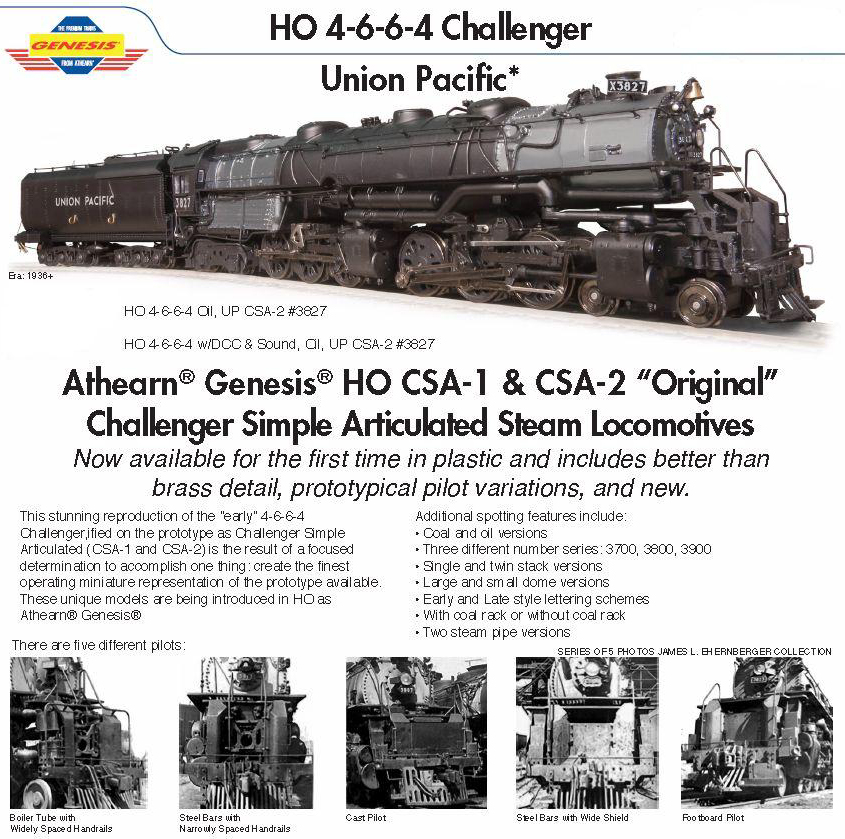
UNION PACIFIC PROTOTYPE HISTORY:
The Union Pacific Challengers were a type of simple articulated 4-6-6-4 steam locomotive built by American Locomotive Company for the Union Pacific Railroad. 105 of these locomotives were built between 1936 and 1943. The Challengers were nearly 122 ft (37 m) long and weighed 284,800 kg. They operated over most of the Union Pacific system, primarily in freight service, but a few were assigned to passenger trains operating through mountain territory to California and Oregon. The locomotives were built specifically for Union Pacific and much of the experience gained later went into the design of the “Big Boy”.
The name “Challenger” was given to steam locomotives with a 4-6-6-4 wheel arrangement. This means that they have four wheels in the leading pilot truck,
which helps guide the locomotive into curves, two sets of six driving wheels, and finally four trailing wheels, which support the rear of the engine and its massive
firebox. Each set of six driving wheels is driven by two steam cylinders. In essence, the result is two engines under one boiler. The Union Pacific Railroad sponsored development of this type to meet the need for higher speeds in main-line service. Historically, articulated locomotives had been limited to slow
speeds by factors inherent in their design. The technical breakthroughs achieved with the Challenger enabled the carrier to develop the Big Boy with the same
speed expectations. Speeds in excess of 60 M.P.H., while unheard-of on other railroads using articulated steam locomotives, became commonplace on the
Union Pacific.
The 105 were divided into five orders, which can be put into two groups: the first two orders of “original” also known as “light” Challengers, and the final three of
“heavy” Challengers.
NP & SPS PROTOTYPE HISTORY:
The Northern Pacific ordered 21 “Challengers” from the American Locomotive Company in 1936 and took delivery of them during 1936 and 1937. These 4-6-6-4s were designated Z-6 and were assigned road numbers 5100 through 5120. They had four 23 x 32 cylinders, 69” drivers, a 250 psi boiler pressure, exerted 104,500 lbs of tractive effort and weighed 624,500 pounds. In 1941, another six “Challengers” came from ALCO. These were designated Z-7 and they carried road numbers 5121 through 5126. They had four 23 x 32 cylinders, 70” drivers, a 260 psi boiler pressure, exerted 107,000 lbs of tractive effort and weighed 644,000 pounds. The last steam locomotives bought by the Northern Pacific were the 20 “Challengers” it purchased from ALCO during 1943 and 1944. This group designated Z-8 was assigned road numbers 5130 through 5149. The Z-8 locomotives were virtually identical to those of Class Z-7. Two oil-burning Z-8s were also delivered to the SP&S.
CLASS Z-8:
This was essentially identical to the 1941 Z-7s. These locomotives were produced under a wartime mandate to replace certain high-strength steel components with similar items produced with more common and heavier steel. Even so, the NP’s diagrams show no difference in the adhesion weight and just a 1,000 lb difference on engine weight.
The firebox heating surface included 136 sq ft in eight circulators. These also featured a bearing design that permitted smooth riding at higher speeds.
Reservations Due By: February 23, 2017
Expected Release: January 2018
REB
Product Details














 © 2026 Pacific Western Rail Systems
Train Addiction Help Line: 1 866 840 7777
© 2026 Pacific Western Rail Systems
Train Addiction Help Line: 1 866 840 7777