Train Addiction Help Line: 1.866.840.7777
Dec 7, 2020 - N Scale
Kato (Japan) - N Scale - New! December 2020 Releases


Kato (Japan) has announced New! December 2020 Releases
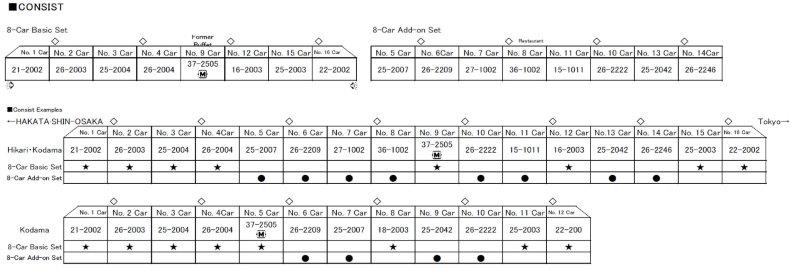
Series 0-2000 Shinkansen “Hikari-Kodama” Passenger 8–Car Basic Set

Since the Tokaido Shinkansenline was opened in 1964, Series 0 Shinkansentrain was built and deployed increasingly more with minor changes till 1986. The train cars newly made since 1981 were numbered 2000s indicating the last version of series 0, and the total of 309 cars were manufactured. Cars numbered 2000s were a group, the seat pitch of which was expanded based on 1000s with side passenger windows changed smaller. 2000s were all transferred to JR Tokai/JR West Japan after the JNR’s privatization and operated as the last series 0 before it was decommissioned in 2008. Series 0 is a famous train in the history of Japanese railways. Please enjoy the lovely design with the round top nose dubbed bulbous nose Prototype is series 0 in the last phase. Head/Taillights turn on. The headlights on the top car model 21/22 are now changed into LED. It appears now like two of the top and bottom lights positioned in a unit are separately on, on right and left sides on the top car.
It was the Series 0 that appeared as the first Shinkansen bullet train in 1964 when the Tokaido Shinkansen Line was inaugurated. Since the introduction of the original Series 0, continual improvements were made to its accommodations until the final version, with #2000 and higher, was developed in 1981. With the passing of nearly 40 years since its debut, most of them are no longer in use yet remain in the memory of many people.
Features
● Pantographs: Changed from Plastic to Metal
● Insulators for pantographs: Newly added
Series 233-2000 “Shinkaisoku” Passenger 4-Car Set

2000s appeared as the best ever version in 1998 trying to reduce the manufacturing costs. The cars are diversified in the form depending on makers and production times. In 2013, extra diaphragms were installed to prevent passengers from falling on the track between cars. It is still now in service as “Shinkaisoku”, etc.
Series 223-2000 "Shinkaisoku" is an urban electric train of JR West Japan, which made its debut in 1999 as a successor of Series 223-1000. It is operated as "Shinkaisoku" (new rapid) train at the maximum speed of 130 km/h. on JR Kyoto and Kobe Lines.
Composition of Trains

Features
● Operative Head/Taillights (with Turn-off Switch)
● Lighted Destination Sign
● DCC Friendly
● Equipped with Suspension Mechanism
● Driving Unit with Flywheel
● User Install. Parts:
● Roof-top details
● Driver for Switch to turn off Light
● Coupler Cover only for 4-Car Set
Old Model Coach Passenger 4-Car Set

Blue old model coaches symbolizing 1970s are the vehicles added with modifications for improvements to catch up with the rising service level of the electric trains and diesel trains which appeared in 1950s at the time of train power modernization. The coaches changed in the color from the conventional brown into blue, one after another, making a fresh impression.
Features
● Old-fashioned passenger car 4-car set (blue)
・A set of four old blue passenger trains, the image seen on the Japanese National Railways after 1964 (Showa 39). Lineup of Oyu 10 (non-cooling), which was also connected to ordinary trains, and 3 cars of Suha 43 series
・Different roof colors (Oha 46 ・ ・ ・ Gray No. 1 Oyu 10 ・ ・ ・ Mouse No. 1 Oha 47 / Suhafu 42 ・ ・ ・ Dark ash)
-The coach has been commercialized with specifications different from the conventional products. The window frame of Suhafu 42 is silver, the window frame of Oha 46 is blue, and the side door of Oha 47 reproduces the original pressed door.
・Oyu 10 and Suhafu 42 have tail lights on (with off switch)
・The affiliation notation is "Sekisui" for each car. The tail light lighting side wife side notation of Oyu 10 and Suhafu 42 is "49-4 Saitama Ko"
● Old-fashioned passenger car 4-car set (brown)
・Easy brown old-fashioned passenger car set with assorted Suuni 60 and 3 passenger cars with unique door arrangement
・All cars are composed of new car numbers. The customer window frames of Oha 46, Suha 43, and Ohafu 45 reproduce the original window (brown), and the customer door reproduces the H rubber window.
・Oha 46 is set by transfer from Suha 43
・Suha 43 is an image of a late-stage expansion car
・Brown Ohafu 45 debuts
- The tail light of Suuni 60 / Ohafu 45 is on. Equipped with a switch for turning off
・The affiliation mark has been printed with "Seki Sui"
・Parts for all cars, bogie mount Arnold coupler, ventilator
MANI 60 200 Coach Passenger Car

Blue old model coaches symbolizing 1970s are the vehicles added with modifications for improvements to catch up with the rising service level of the electric trains and diesel trains which appeared in 1950s at the time of train power modernization. The coaches changed in the color from the conventional brown into blue, one after another, making a fresh impression.
The Mani 60 200 is a luggage car with four central windows and a wooden luggage door. It was connected to the passenger car train together and was active all over the country. JNR locomotives such as ED70, ED71, ED75, EF70, EF80, EF81, EF57, EF58, ED76, DD13, which were active after the modernization of power, are recommended for traction machines. You can add more passenger cars and luggage cars to your liking for even more fun.
Mani 60 200 Features:
-Reproduce the appearance with four central windows and a wooden luggage window on the body of grape color No. 2.
・ Tail light lights
・ The affiliation notation is "North Sumi". Tail light lighting side wife side notation is "44-3 Omiya Ko"
・ Arnold coupler standard equipment
Order Due Date: December 18, 2020
Anticipated Delivery Date: June 2021
Looking for more Kato (Japan) N Scale Passenger Cars? Click here!


Product Details




 © 2026 Pacific Western Rail Systems
Train Addiction Help Line: 1 866 840 7777
© 2026 Pacific Western Rail Systems
Train Addiction Help Line: 1 866 840 7777