Train Addiction Help Line: 1.866.840.7777
Mar 16, 2021 - N Scale
Micro-Trains - N Scale - PWRS Exclusive Runs... Running out...



Dear N Scale Customers;
There are only a few left of the Micro-Trains PWRS Exclusive runs!
If you were waiting for that sign to tell you it's time to order yours....
Well Here's Your Sign!

Canadian National (CNA) 50ft Plug & sliding Door Boxcars made for Pacific Western Rail Systems
Pacific Western Rail Systems is pleased to announce our new run of “Canadian National Noodle” - Limited Run PWRS – Micro-Trains 4 car Runner Pack.
This set will feature four CN 50ft Insulated Plug & Sliding Door Boxcars painted CN Boxcar Brown with an aluminum roof, white lettering and the CN "Wet Noodle" Herald. The cars will have light weathering and the florklift pockets will be painted yellow. They were built 1979 by FMC as part of CNA series 553000-553999.
Features:
- Limited one time production run of these 4 road numbers
- Micro-Trains trucks and couplers
- Accurate painting and printing with correct road numbers for each paint scheme.
- Cars will feature weathering to reflect real world appearance
The Official Micro Trains SKU numbers for the individual cars in the set are (for purposes of collectors):
Pack# 026 90 001 NSE MTL16-186
026 91 001 RD# CNA 553605 - NSE MTL16-182
026 92 001 RD# CNA 553616 - NSE MTL16-183
026 93 001 RD# CNA 553738 - NSE MTL16-184
026 94 001 RD# CNA 553743 - NSE MTL16-185
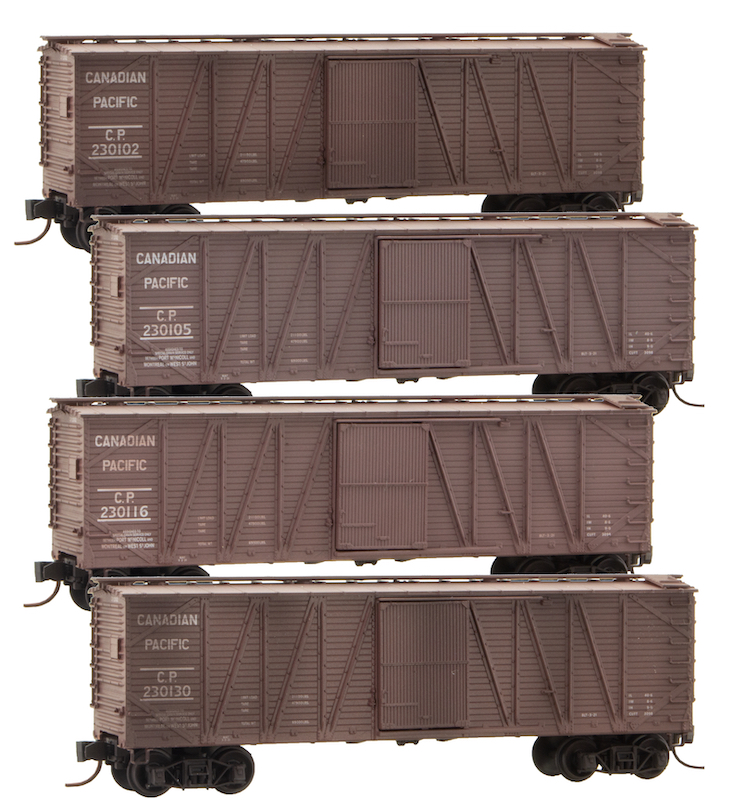
This 40' outside-braced boxcar, single door will be painted brown, and proudly display the Canadian Pacific name in white gothic lettering. It runs on black arch bar trucks and will be moderately weathered to simulate a real world appearance. When built in March of 1921, this box car had special hopper doors fabricated into the floor for grain service. The hoppers could be covered on the inside of the car to allow service as an ordinary box car. The hopper doors were removed during the 1930s. Canadian Car & Foundry, National Steel Car, Eastern Car Company and Canadian Pacific's own shops built 9,000 of these cars between 1920 and 1921.
This is a Pacific Western Rail Systems exclusive 4-Pack.
Features:
- Detailed underside
- Detailed sides and ends
- Cars are available ready to run
- Equipped with Micro-Trains trucks couplers
The Official Micro Trains SKU numbers for the individual cars in the set are (for purposes of collectors):
Canadian Pacific (CP) 4 - PACK - 028 90 120
- 028 91 120 – CP # 230102
- 028 92 120 – CP # 230105
- 028 93 120 – CP # 230116
- 028 94 120 – CP # 230130

This limited run of 40 ft Standard Canadian National Grain Boxcars with a minimum run of 50 sets, will be an excellent gift for all CN fans! Order yours today through your PORTERS account and earn valuable Micro-Trains Manufacturers Credits towards select PWRS PORTERS Micro Trains Club Lounge Cars.
Boxcars were the freight car of choice for grain transportation from the early 1900's until they were replaced by gravity-discharge aluminum and steel covered hoppers beginning in the 1970's. The covered hoppers were easier to load and unload. Boxcars required wooden or cardboard grain doors, to hold the cargo in while the car was being loaded via the door. We have simulated this by providing 2 cars with Plywood inserts and two with cardboard inserts. In 1987, terminal car dumpers still existed for boxcar unloading, but they were quickly aging, and costly to repair and operate. Grain boxcar fleets declined through attrition, and the railways' intention after 1986 to use them only on branchlines unable to accommodate the heavier covered hoppers.
The Canadian Federal government boxcar rehabilitation schemes were undertaken in 1979 and 1980. The floors, nailable door areas, spot welding, and doors were repaired and spray painting was done. A yellow wheat sheaf, a smaller version of the government grain hopper scheme, was applied to the left of the door. Under it was a stencilled a bilingual message, reading in part, "REPAIRED WITH FINANCIAL CONTRIBUTION FROM THE GOVERNMENT OF CANADA".
073 91 009 CN #428635 w/ paper doors w/ Superior Door
073 92 009 CN #428649 w/ paper doors w/ Superior Door
073 93 009 CN #428168 w/ wood doors w/ Youngstown Door
073 94 009 CN #428223 w/ wood doors w/ Youngstown Door
Proto-type photo CP 252797 used courtesy of Beiseker Railway Museum.
The way the grain agent would load these cars is a little different from a modern hopper. First the agent would climb into the car with all the materials he would need along with a ladder ( this was very important ). The agent would nail a large piece of cardboard over the door opening from the inside. He would leave a few feet of room at the top open to load the car with. He would then re-enforce the cardboard with metal strapping. This procedure was repeated for the other door as well. Then the agent would use the ladder to climb out of the car through the opening he had left at the top of the door. At the ports a large scoop with a spiked end was rammed through the cardboard door to unload the car. The job was finished by sweeping the remains out of the car.
Loading levels were painted on the inside of the car to tell the agent how much to load to. There are different levels for Oats, Barley, and Wheat as these all weighed different amounts and the car could not exceed a set tonnage.
Photos courtesy of Eric Gagnon
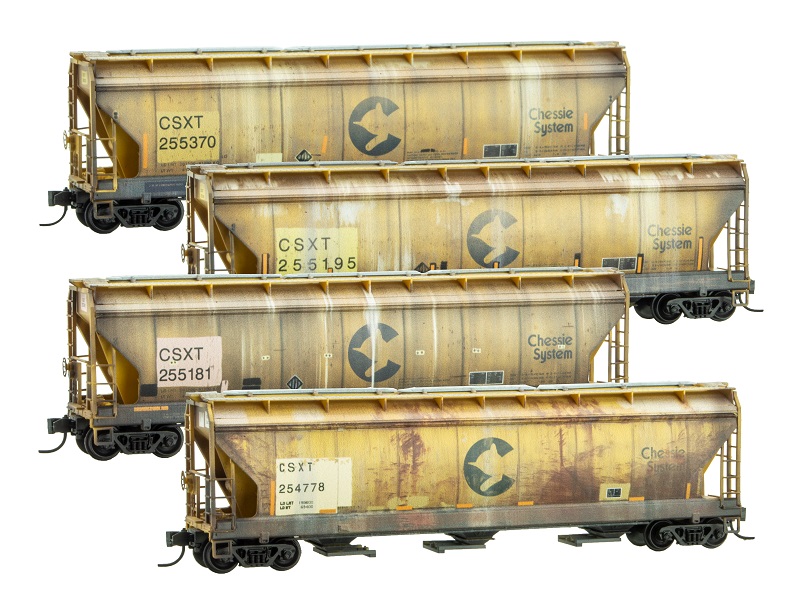
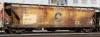
These 4600 cu.ft. 3 Bay Centerflow Covered Hoppers are painted yellow, with black lettering, and will feature moderate to heavy ‘specific’ dirty, rusty weathering effects to simulate a real world appearance. All cars will have reflectors. Gravity fed, these hoppers are 100 tons, measure 55' 5" long, and run on Barber Roller Bearing trucks.
This is a Pacific Western Rail Systems exclusive 4-Pack.
Features:
- Detailed underside
- Detailed sides and ends
- Detailed roof walk
- Cars are available ready to run
- Equipped with Micro-Trains trucks couplers
The Official Micro Trains SKU numbers for the individual cars in the set are (for purposes of collectors):
Chessie System (CSXT) 4 - PACK - 094 90 038X
- 094 91 038X – CSXT #254778
- 094 92 038X – CSXT #255195
- 094 93 038X – CSXT #255370
- 094 94 038X – CSXT #255181


This 50’ gondola with fishbelly sides and drop ends is painted black with white word mark and lettering. They were built by Eastern Car Company as part of the CP 340500-340999 series BLT 6-8/53; and CP 341700-341899 series BLT 10/56. They were in service until 2002. This is a Pacific Western Rail Systems exclusive 4-Pack.
Features:
- Detailed underside
- Detailed sides and ends
- Tie load
- Cars are available ready to run
- Equipped with Micro-Trains trucks couplers
- Special weathering applied to cars to simulate prototypical prototype appearence.
Official Micro-Trains SKU numbers for the individual cars included in the set (for purposes of collectors):
Pack# 046 90 029 NSE MTL18-08
046 91 029 – CP 341532 NSE MTL18-04
046 92 029 – CP 341589 NSE MTL18-05
046 93 029 – CP 341634 NSE MTL18-06
046 94 029 – CP 341668 NSE MTL18-07

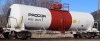
These 54 ft. 23,000 gallon cars will be sold in a single 4-Pack featuring 4 different road numbers. By combining cars from this 4-Pack with previously released 4-packs from our North American Petroleum Tank Car Series, modelers will be able to build a prototypically accurate consist of these cars as seen across Canada and the Northern United States.
Features:
- Limited one time production run of these 4 road numbers
- Micro-Trains trucks and couplers
- Accurate painting and printing with correct road numbers for each paint scheme.
- Cars will feature subdued yellow reflective markings and light weathering to reflect real world appearance
Procor is a Canadian company producing railway shipping cars. It is Canada's largest private rail car rental fleet, with more than 21,000 conventional and special-purpose tank and freight cars.
Linked to Sparling Tank Car of Toronto, Procor was founded in 1952 as Products Tank Line Limited and became an affiliate of US-based Union Tank Car Company. The company, which shortened its name to Procor in 1962, is headquartered in Oakville, Ontario
Micro-Trains Part Numbers for the cars in each pack:
- 110 90 038 Procor (Procor Limited ) 4-Pack -
- 110 91 038 Car # PROX #12016
- 110 92 038 Car # PROX #12074
- 110 93 038 Car # PROX #12092
- 110 94 038 Car # PROX #12152


Canadian Pacific TOFC 3-pack with Reimer Trailers 3-pack – Pacific Western Rail Systems
We will not re-print.
Pacific Western Rail Systems is pleased to announce the fifth issues in our new “Canadian Trailer on Flat Car Series” - Limited Run PWRS – Micro-Trains Runner Packs.
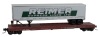
Pack #1 will feature three CP 57’ Converted TOFC Flat Cars painted red with white lettering. They were built 1965 by Napanee Industries, of Napanee, Ontario as part of CP Rail series 505001-505389 and ride on roller bearing trucks.
Pack#2 will feature three CN 57’ Converted TOFC Flat Cars painted brown with white lettering. They were built 1968 by Napanee Industries, of Napanee, Ontario as part of Canadian National series 687200-687274 or 687300-687323 and ride on roller bearing trucks.
Features:
- Limited one time production run of these 3 road numbers & three separate trailers
- Micro-Trains trucks and couplers
- Accurate painting and printing with correct road numbers for each paint scheme.
- Cars will feature light weathering to reflect real world appearance
The Official Micro Trains SKU numbers for the individual cars in the set are (for purposes of collectors):
452 91 011: Reimer Trailer # XXXX
064 92 126: CP Flat - CN # TBA
452 93 011: Reimer Trailer # XXXX
064 94 126: CP Flat - CN # TBA
452 95 011: Reimer Trailer # XXXX
064 96 126: CP Flat - CN # TBA
CN and CP operated sizeable fleets of piggyback trailers. Prior to containerization, piggyback or Trailer On Flat Car (TOFC) was an important transitional step between boxcars and intermodal technology developments, which in turn led to today's long trains of double-stacked containers.
Initially, piggyback loading/unloading ramps were built at or near major yards. Tractors backed trailers on and drove them off strings of flat cars, a process called circus loading. Drawbacks: truck drivers had to have steady hands and nerves, flatcars needed siderails to guide the drivers through several cars, and cars had to be correctly marshalled to match the ramp at which they were to be unloaded.
The last Image, "Trackside Treasure", below is courtesy of Eric Gagnon. He has a great Blog on Canadian Trains which can be viewed at:
http://tracksidetreasure.blogspot.ca
Can't get enough of the Micro-Trains PWRS Exclusive Cars? Click Here!
Product Details





 © 2026 Pacific Western Rail Systems
Train Addiction Help Line: 1 866 840 7777
© 2026 Pacific Western Rail Systems
Train Addiction Help Line: 1 866 840 7777