Train Addiction Help Line: 1.866.840.7777
May 10, 2021 - N Scale
Kato (Japan) - N Scale - May 2021 Releases


Dear N Scale Customers;
Kato (Japan) has announced May 2021 Releases
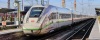
ICE4 Passenger Car Sets

● Deutsche Bahn launched the high-speed trains ICE4 from December 2017.In 2018 as part of the marketing of activities to adopt an environmental conservation system that has been carried out in Europe ,the design of the train body change the red line to a green line to representing environmental conservation, and the number of operating trains has been increased.
◆ KATO will release ICE4 painted with a very eye-catching green line train and you are able to operating with re-run product 10-1512 ICE4.
① The prototype is No.9034. Setting a car number different from previous products.
② The green line in front of the leading car, plug design and logos are reproduced finely.
③ Black wheels are used according to the appearance image of the actual cars.
④ A motor car will be installed in the Basic set and the “B” Add-on set. Considering the cooperation of motor car, the motor car of the Add-on set does not mount traction tires.
⑤ Flywheel is adopted to realize stable operation.
⑥ Installed a longer reflection lens to match the train car body’s length. Combination with separately sold lighting sets will enable lighting.
⑦ Minimum turning radius : R282
⑧ KATO DCC plug system available.
⑨ The Add-on set uses a special large-sized book case. The Basic set of cars can be stored in the Add-on set A.
Composition of Trains
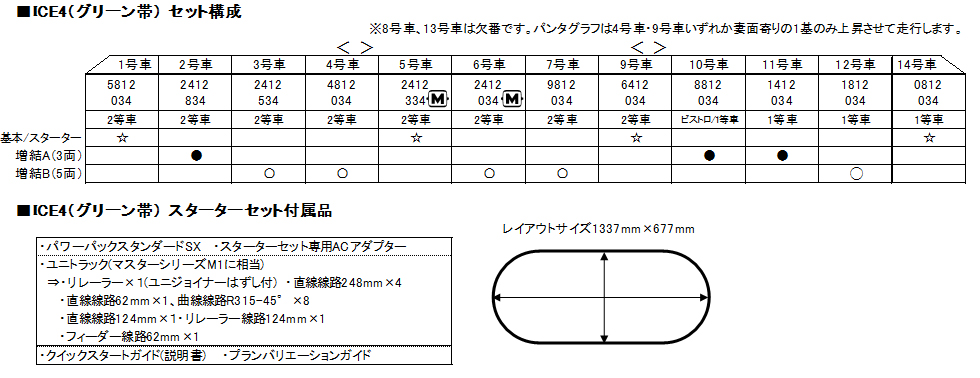
Anticipated Delivery Date: November 2021
ICE4 7-Car Basic Passenger Set
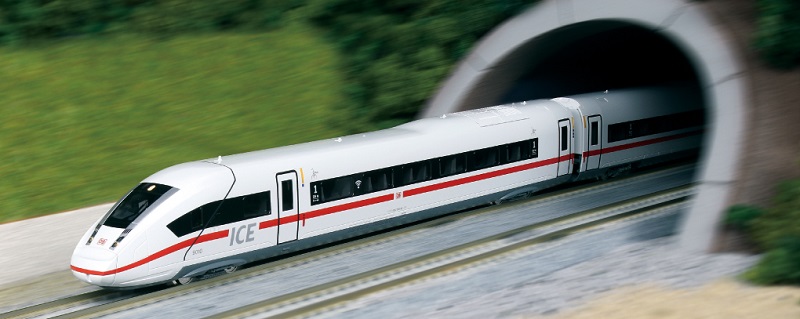
ICE 4 will join the lineup of Kato’s world high-speed train models..
ICE 4 is the 4th generation model of the German ICE (Intercity Express), one of the high-speed trains on European mainline network.
ICE 4 was developed as a train consisting of 12 cars adopting distributed-traction-system with emphasis on increased comfort for passengers travelling at the maximum speed of 250 kilometers per hour in a long distance train. It also aims to enhance the transport power in various areas in Europe as an international train, which service will start in 2020, in addition to the current operation between German cities and regions.
Kato will make the N-scale train model in combination of 7-car basic and 5-car add-on sets.
ICE 4 is the 4th generation model of the German ICE (Intercity Express), one of the high-speed trains on European mainline network.
ICE 4 was developed as a train consisting of 12 cars adopting distributed-traction-system with emphasis on increased comfort for passengers travelling at the maximum speed of 250 kilometers per hour in a long distance train. It also aims to enhance the transport power in various areas in Europe as an international train, which service will start in 2020, in addition to the current operation between German cities and regions.
Kato will make the N-scale train model in combination of 7-car basic and 5-car add-on sets.
Composition of Trains

Features
● Minimum Turning Radius: R282 (11”)
● The streamlined top car’s sharp shape characterizing ICE4 is realistically reproduced.
● The train’s exterior of the high-speed train is accurately reproduced with the black side windows and red horizontal belt.
● Such letterings as signs seen here and there and car Nos. are precisely printed.
● The trucks on trailer cars are reproduced with exposed wheels with exposed brake disks.
● A car with motor is put in the basic set and the other in the add-on set one in each set. To achieve coordinated move of the two cars each with motor the motor car in the add-on set does not wear traction tires.
● The motor unit with flywheel ensures stable run of the train.
● Longer reflectors matching the longer car bodies are already installed. The separately sold LED lighting sets made for the longer cars will illuminate the train in combination with the reflectors.
● The couplers between the middle cars will be newly made representing the perimeter diaphragms. The top cars have no couplers.
● Operative head/taillights. The headlights use the light bulb color LED.
● DCC friendly
● Book case style package used for basic/add-on sets with width longer than the conventional package.
ICE4 Sound Card
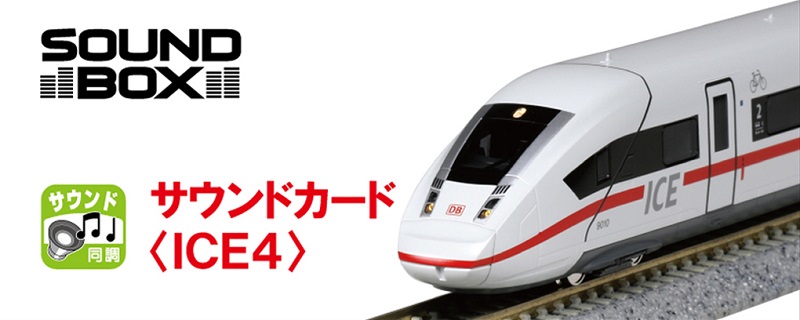
You can enjoy the sound of ICE4 like traveling such as sound broadcasting at the time of departure ~ boarding, in-vehicle broadcasting and ticket inspection of conductor at station.
Composition of Trains

Features
Please use the QR cord for sound samples.
Anticipated Delivery Date: August 2021
Series 485-200 / Series 485 Limited Express "Midori" Passenger Sets
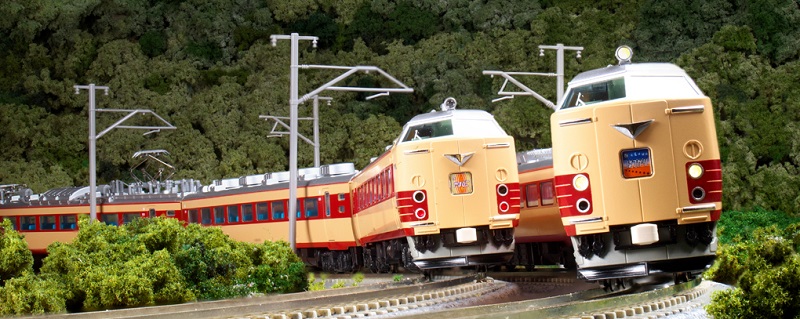
Kato will make the scale model of Series 485-200, the first version of the electric rice cooker by nickname.
It is the model which emerged in 1972 with the top car equipped with a gangway door and the air conditioner changed to floor installation model AU71A in order to accommodate more passengers. Since 1976, the train combining limited expresses “KAMOME” and “MIDORI” started the service between Hakata and Nagasaki/Sasebo. “MIDORI” was much talked about as the then shortest limited express train just consisting of 4 carriages.
By combining the 6-car basic set with those to be released simultaneously such as #10-1129 Series 485 Late Stage 2-Car Add-On Set, #4556 SAHA 481 Early or #4570 SARO 481 you make and enjoy former famous limited expresses such as “YAMABIKO”, “RAICHO” or “NICHIRIN” as well as the combination of “KAMOME” and “MIDORI”.
Composition of Trains
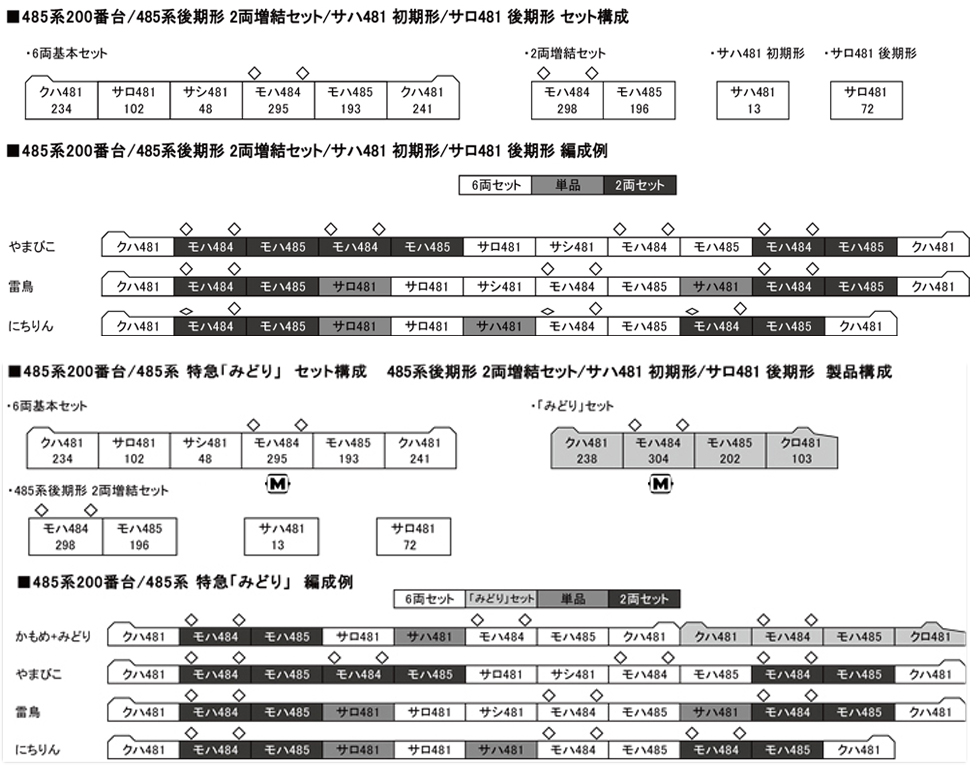
Main features
- The prototype is the figure around 1978-60 (1978-1985) when the head mark was illustrated.
- The first "electric kettle" style Kuha 481 type 200 series, accurately reproducing the forehead with a through door according to the 581 series
- The late type 2-car add-on set is a centralized cooler AU71A, Moha 484 Reproduce the appearance of Moha 485 equipped with distributed AU13E
● Saha 481 reproduces the appearance of mushroom type cooler AU12, Salo 481 reproduces the appearance of late type AU13E cooler
● The front coupler of the leading car of the 6-car basic set is dense Shape dummy coupler standard equipment. Replaceable with a dummy coupler that reproduces the coupler cover
● 6-car basic set Kuha 481 has head / tail lights and train marks lit
● Body mount type KATO coupler close-coupled type (with hook) at the intermediate connection part of each car
● Standard equipment
● Stable running with a power unit equipped with a flywheel
● DCC friendly
● Type Sabo has "Limited Express" printed. Car No. Sabo is in a white background, and you can attach your favorite car number from the attached sticker. Side destination display is also included You can attach your favorite destination display from the sticker
● Kuha 481 is equipped with a conversion type nickname display
● Train mark conversion device Contents ・ ・ ・ 6-car set: "Yamabiko" "Thunderbird" "Kamome" "Nichirin" (All illustrations)
- The limited express "Midori" 4-car set is reproduced in the form of 1982-60 (1985).
- The replaceable train mark of Kuro 481 103 is already equipped with "Midori (illustration)". "Green (character)", "temporary", and "group" are available for replacement.
- Kuro 481 103 reproduces the appearance without a short red belt like the "beard" at the beginning, which is peculiar to the Kyushu
area.
- Used for the Kuha 481 200 series. Includes 2 sets of couplers for connecting the front part. If you attach it to the "Midori" set and the Kuha 481 200 series of the 200 series 6-car basic set, you can reproduce the combined formation of "Kamome" + "Midori"
- The Kuha 481 has a light-off switch.
- No traction tires for motor vehicles in consideration of smooth combined operation.
・Conversion type nickname display Contents ・ ・ ・ 4-car set: “Midori (illustration)” “Temporary” “Group”
● Train mark conversion device for 485 series 200 series (JNR / illustration)
・Recording contents: ① “Hatsukari” "Hibari" "Swan" "Inaho" ② "Hitachi" "Toriumi" "Aizu" "Shirasagi" ③ "Hokuetsu" "Kaetsu" "Spur" "Ariake"
MANI 44 Luggage Car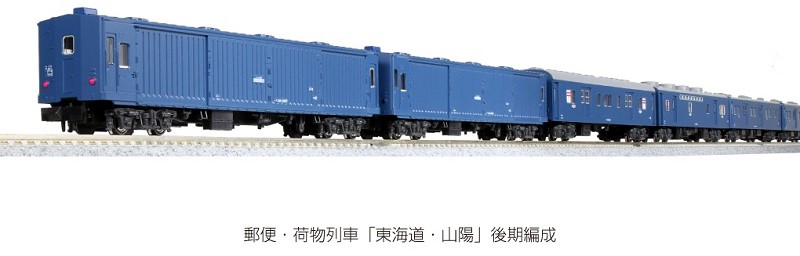
During the Showa era, luggage transportation by rail was carried out by luggage cars connected to passenger trains, but as the amount of transportation increased, dedicated luggage trains began to operate, and the Tokaido / Sanyo Main Line and Express luggage trains were also operated on trunk lines such as the Tohoku Main Line.
In 1968, pallet transportation began with a new pallet car that appeared as a trump card for the modernization of luggage transportation. Among them, Mani 44 is called the completed version of the pallet luggage car. At first glance, it looks like a freight car, and you can see it playing an active role in combination with conventional luggage cars and postal cars.
Composition of Trains

Main features
Postal / baggage train "Tokaido / Sanyo" late formation 6-car set
- Printed notation for each vehicle
- Mani 44 2067 and mani 50 2217 for 6-car set, mani 44 2109 for single item also printed format, own weight, inspection notation
· At any vehicle, truck mount type of Arnold coupler adopted
Mani 44 (6-car set), including the Shin pallet freight cars, in the organization was seen in mid Railways end, Mani 44 and hot water 14 200 is the first product of
Mani 44 2067 has a tail light on only on the passenger compartment side (with a light-off switch), DCC Friendly
Oyu 14 200 (6-car set), reproduces the appearance with few division shelves called the East Gate special car, reproduces the frosted glass window, and the passenger compartment Tail light board can be incorporated on the side (DCC friendly)
Mani 50 (6-car set)
・Mani 50 2217 has tail light on only on the passenger compartment side (with off switch)
Mani 44 (single item)
・The entire body is painted with blue No. 15. Characteristic appearance with a passenger compartment and an entrance / exit stand in front of and behind the luggage compartment
・Tail light on only on the passenger compartment side of Mani 44 2109 (with a light-off switch)
・DCC friendly
A 6-car set that is suitable for reproducing a main line luggage train, with a series of postal / luggage trains "Tokaido / Sanyo" and luggage-only passenger cars with various histories. In addition, two models, Mani 37 and Mani 60, will be released separately for additional connections.
- For Mani 60, a modified car from Ohani 61, which is the same as the "Niseko" set, was selected as a prototype. The body color is brown.
- For Mani 36, a modified car from the same Slone 30 as the "Tsugaru" set was selected as a prototype. The body color is brown.
- Suni 41 reproduces the form without a gangway door. Select Suni 41-5 as the car number. The body color is blue / silver.
・For Suni 40, select Suni 40-8 because the car number of the single item (8005) is different. The body color is blue / silver.
・Oyu 12 is selected as Oyu 12-34 because of the different car number of the single item (5059-2). The body color is blue.
- Both ends of the set (Suni 41, Mani 36) and the single vehicle have tail lights on (only on one side) and off switches.
・All vehicles are equipped with Arnold coupler as standard equipment. Only the set comes with two replacement knuckle couplers at the knitting end.
・As for the package, a 6-car set comes in a book case (6 cars + locomotive). 2017 selected from Oku as a prototype of a modified car from Mani 37 (single item) and Suro 60. Body color is blue
Mani 60 with clear case (single item)
・A modified car from Ohani 61 was used as a prototype, and 2653 belonging to Sumida River was selected. The body color is brown
Suyu 44 with clear case (single item), pallet cargo handling postal car that appeared in 1971, and is a privately owned passenger car owned by the Ministry of Posts and Telecommunications. Only the roof and wife's surface are blue, and 24 pallets can be stored in the aluminum press structure. Due to the abolition of railroad mail transportation in 1986, all cars were scrapped the following year.
・ In a clear case
Looking for more Kato (Japan) N Scale Passenger Cars & Sets? Click here!
KOKI 104 Freight 2-Car Set Without Container
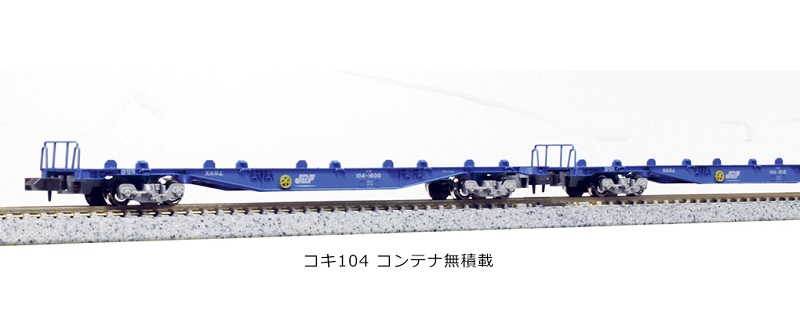
It is a new series container freight car that is perfect for locomotives currently active, such as DC electric locomotives EF200, EF210, EH200, AC / DC electric locomotives EF510, EH500, and JNR type EF65, EF81.
The Koki 104 type is a blue container freight car that appeared in 1989 and can be operated independently in consideration of the increase and disassembly. More than 3,000 cars have been mass-produced.
The Koki 106 type is a gray container freight car that appeared in 1997 and is suitable for loading marine containers.
KATO will commercialize a 2-car train of Koki 104, which has received more requests than before, with no container loaded and empty.
The actual cars are not only Koki 104, but also Koki 106 and other Koki 100 series, as well as Koki 200 and Koki 50000, which are connected to each other on a daily basis.
In addition to loading your favorite container, you can enjoy the appearance such as the frame shape that is precisely reproduced even when the car is empty, and the dark blue paint color that is closer to the actual car.
Composition of Trains

Main features
● Koki 104
Accurately reproduces the frame shape where details such as piping can be seen on the underframe that is not loaded with the container .
- Ensures stable driving performance even when the vehicle is empty.
- Reviewed the paint color of the vehicle and changed it to dark blue. Faithfully reproduce the color of the actual vehicle.
・Set a different car number from existing products.
・Inspection notation is Koki 104 1715: 29-9-11 / 24-9-11 Hiroshima car, Koki 104 2406 33-10-27 / 28-10-27 Hiroshima car. The inspection cycle notation is A11.
● Container freight car Koki 104 ・ Koki 106
・The frame shape is faithfully reproduced with the underframe removed and complicated piping visible. Even when the container is empty, you can appreciate the detailed details that approach the actual vehicle.
- Reproduce the hand brake handle in yellow as in the actual vehicle.
- Realistic reproduction of the car body notation.
- Beautiful and realistic expression of the details and notation of the loading container. Each container has a different number. In addition, the 19D container is labeled as "environmentally friendly railroad container," "environmentally friendly rail freight transport," and "eco rail mark."
- Containers can be easily transshipped.
- Koki 106 reproduces the container stopper on the upper surface of the underframe and newly sets a removable reflector.
・2-car set
・Koki 104 ・ ・ ・ Commercialized with blue 18D containers (5 pieces) loaded.
・Koki 106 ・ ・ ・ Commercialized with JRF Red 19D containers (5 pieces) loaded.
・Accessories (parts with user) ・ Brake handle ・ Reflector (Koki 106 only)
・Arnold coupler equipment
Looking for more Kato (Japan) N Scale Freight Cars & Sets? Click here!
Anticipated Delivery Date: November 2021
U38A Container (Nissan Land Transport)

Both the "U38A container type" and "U41A container", which were active in Nissan's automobile transportation, are containers intended for automobile transportation by rail, and have a tricolor color and curved ceiling that other containers do not have.
Anticipated Delivery Date: August 2021
U41A Container
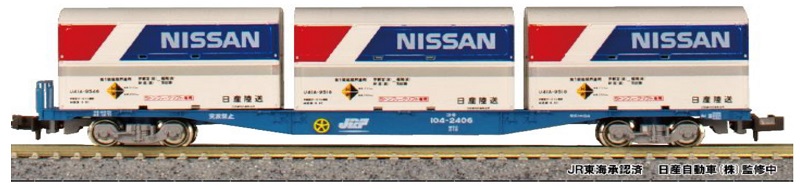
The shape was a gray band, and the U38A type had a shorter height and width than the U41A type and had a blue band. The U41A type is responsible for the transportation of passenger cars and the U38A type is responsible for the transportation of light vehicles, and was nicknamed "Carpack" and "Carpack 2", respectively.
Anticipated Delivery Date: November 2021
Composition of Trains

Main features
- Reproduce the characteristic appearance with a rounded upper part according to the vehicle limit
- Beautifully reproduce the colorful tricolor color and the notation of the owner company name "Nissan Land Transport"
- The U41A container has a gray belt, the U38A container type has a belt Reproduces the blue feature.
- The U38A container type reproduces the appearance without non-standard display.
- Each product contains 3 pieces. All set with different container numbers
・The best match is loading on separately sold container freight cars (Koki 5000, Koki 104)
● Kato will make a new item U38A Container (Nissan Rikusou) 3 pcs./set and reproduce 23- 503 U41A Container (Nissan Rikusou) 3 pcs./set simultaneously.
Both containers were used for railroad transport of vehicles made by Nissan Motor Co., Ltd. They shared with each other a distinctive character of tricolor striped livery and round roof. But U41A donned a gray belt while U38A had a blue belt and was shorter than the other in the height and width. U41A carried standard vehicles and U38A transported smaller cars, respectively nicknamed “Car Pack” and “Car Pack 2”.
Looking for more Kato (Japan) N Scale Containers? Click here!
Order Due Date: May 24, 2021
Looking for more Kato (Japan) N Scale Products? Click here!

Product Details






 © 2026 Pacific Western Rail Systems
Train Addiction Help Line: 1 866 840 7777
© 2026 Pacific Western Rail Systems
Train Addiction Help Line: 1 866 840 7777