Train Addiction Help Line: 1.866.840.7777
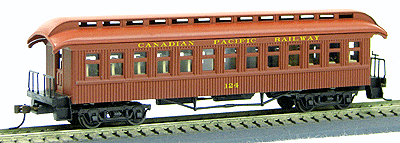
Con-Cor - HO Scale - 1880s Wood Open-Platform Coach - Canadian Pacific (CP) #127 - [See 223-231 Rd #121, 223-15631 Rd #122, 223-15632 Rd #125] - CP Red (SKU 223-15633)
Available On: January 1, 2015

BACKGROUND:
Passenger service in the 1800s looked very different from what would come a century later. To begin with, most travelers didn't go very far. On longer runs, trains stopped at railroad owned hotels and restaurants for food service and overnight stays. As a result, paying passengers had little reason to move between coaches. Therefore, open platforms on the ends of the cars were not a problem.
The advent of dining, parlor, and sleeping cars led to more people moving > between cars and enclosed vestibules followed shortly after. Open platform coaches would continue in local, mixed train and commuter service for decades.
This group of runs is coming in 10 road names with a total of 12 paint schemes:
SHORT HISTORIES:
The Denver & Rio Grande Western was the result of the 1921 reorganization of the Denver & Rio Grande and the Rio Grande Western (who had been leased by the D&RG.) The two had originally been built to 3' gauge linking Denver, Pueblo and Ogden. By 1890, that mainline had been standard gauged. Many lines in southern Colorado and northern New Mexico remained 3' gauge until they were abandoned or transferred to tourist train operators.
The Virginia & Truckee was built in 1868 to link Virginia City and Carson City with the Central Pacific mainline in Reno, Nevada. In the mid 1900s, the V&T became the place to go to see ancient locomotives and cars still plying their trade as originally intended.
The Central Pacific was the western half of the original Transcontinental Railroad completed in 1869. The CP took control of the Southern Pacific and the two lines built routes around the west under both charters. Eventually, the CP was merged into the Southern Pacific.
The Pennsylvania had always been a powerhouse. As early as 1854, they had double-tracked their Philadephia to Pittsburgh mainline! Their coach fleet would ultimately number in the thousands.
The Union Pacific was the eastern half of the original Transcontinental Railroad. They gradually built their own line to the Pacific at Portland and later to Los Angeles in addition to spreading across the plains.
The Santa Fe was chartered in 1859 to build from Kansas to Santa Fe, New Mexico. The famous Fred Harvey company provided Santa Fe's hotel and restaurant services en route.
The Durango & Silverton was born when the D&RGW sold their 3' gauge tourist train operation between it's namesake cities in southern Colorado. This road name is available in three different paint color schemes.
The Great Northern was born in 1881 with the reoganization of several lines building westward from the Great Lakes to the Pacific. The line to Seattle was finally completed in 1893.
The Canadian Pacific is credited with stitching together Canada as it's construction was mandated when British Columbia joined the confederation in 1871.
Canadian National appeared in 1922 with the nationalization of several ailing trunk lines. Even older equipment received the new name and paint.
Features:
- HO Scale, standard gauge.
- Authentic 19th Century styling.
- Operating HO knuckle couplers.
- Fully assembled and ready to run.
- Come with Interiors
- Separate "Add-on" Interior lighting kits available
$35.98 US
Country of Origin: China
Something else you might be interested in:
 © 2026 Pacific Western Rail Systems
Train Addiction Help Line: 1 866 840 7777
© 2026 Pacific Western Rail Systems
Train Addiction Help Line: 1 866 840 7777