Train Addiction Help Line: 1.866.840.7777
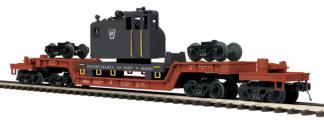
MTH - Premier - O Scale 3-Rail - 75 ft Depressed Flat Car w/Crane Cab - Pennsylvania (PRR) - #470277 (Brown) (SKU 507-2095238)
Available On: July 1, 2017

For transporting large or heavy items over land, nothing beats a railroad flat car. No wonder that manufacturers use flat cars to ship products or sub-assemblies ranging from transformers to airliner fuselages to heavy construction and mining equipment.
But how big is too big? That is determined by a railroad's loading gauge, which defines the maximum height and width of rolling stock and engines. Great Britain, the birthplace of railroading, has one of the smallest loading gauges because so much of its network has bridges and tunnels built in the mid-1800s, when trains were smaller. In the US, older, more urban eastern roads tend to have smaller loading gauges than western roads that traverse wide-open spaces. That's why, for example, 1950s-era vista-dome passenger cars were common on western railroads but rare in the east.
Today the Association of American Railroads (AAR) defines loading gauges in terms of Plate designations from B to K, with the Plate C height of 15'6" being the most common. The tallest North American loading gauges are the Plate H requirement for double-stack container cars and the Plate K requirement for Autoracks, both 20'2".
$99.95 US
Country of Origin: China
 © 2026 Pacific Western Rail Systems
Train Addiction Help Line: 1 866 840 7777
© 2026 Pacific Western Rail Systems
Train Addiction Help Line: 1 866 840 7777