
Train Addiction Help Line: 1.866.840.7777
Tam Valley Depot - All Scales - DCC - Octocoder Stationary Decoder Add-on for Octopus II/III (SKU 7040-OCD001)
Available On: April 1, 2019

The Turtle is stall motor driver designed to run turnouts. It can be used with a number of popular stall motors including the TortoiseTM, SwitchMasterTM, the MP1, MP5, CobaltTM as well just about any 3-12V geared motor. It uses the TVD Fascia Controller for local control and DCC for remote control. It can also be powered with DC if the DCC control is not needed
Uses the Fascia Controller for local control and M-F jumper wires for wiring the motor. Unique features, speed trim pot, fascia controller, 1 Amp drive current (can wire an entire double crossover off of one board), local controller DCC lockout (address+1).
Octopus III Eight Servo Driver with Remote Aligner Tool
The Octopus III can drive up to 8 servos to move turnouts or other devices on your layout controlled by a toggle switch, a momentary pushbutton, the output of a signal system or a DCC decoder. There are 8 positions for plugging in R/C type servos and 8 inputs for switches or 5V logic.
The Remote Aligner allows you to stand by the turnout being aligned so you can precisely align the servo endpoints with ease. No more hanging under the layout trying to push buttons. The servo endpoints are found automatically by searching for hard endpoints or you can manually align them with the Remote Aligner. This allows each servo to be adjusted to its optimum range and endpoints and each servo can be independently adjusted. With the Remote Aligner you can set the amount of force used in the automatic alignment to match your rail size and the servos you are using. The board also has jumpers for setting the range from +/-20 degrees around center to +/70 degrees and for centering the servo to simplify installation for applications where there are no hard endpoints or where you are using the same turnouts in all locations.
The Octopus III has an on-board high-frequency switching 1.8A power supply that is more efficient than the old linear power supply. This means less heat and a lower power draw. Power input is any power supply from 5.0-24 volts DC.
You can use the same fascia controllers as the Quad. This gives you a simple way to hook up the inputs to the board using servo-style cords and extensions. You can use "Y" cords to use more than one fascia controller to control one servo. You can also use a "Y" to connect two servos to one output (works great for passing sidings!).
This board has no DCC input. If you want DCC control of your servos then see the Quad Servo Decoder or you can add an Octocoder (see below).
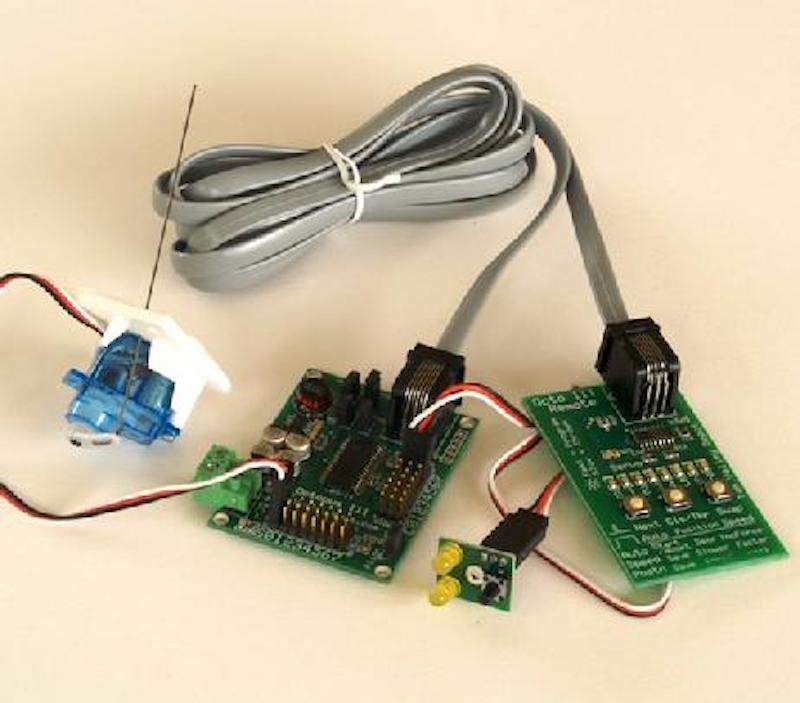
The Octopus turnout control system. Left to right - R/C servo and Servo Bracket, Octopus III, Fascia Controller, Remote Aligner connected to Octopus III with 7 foot cable.
DCC Add-on for the Octopus II/III
By adding this DCC stationary/accessory decoder to the Octopus you can control your turnouts with servos and DCC at the lowest possible cost per turnout. No frills just throws the turnouts from your throttle or JMRI.

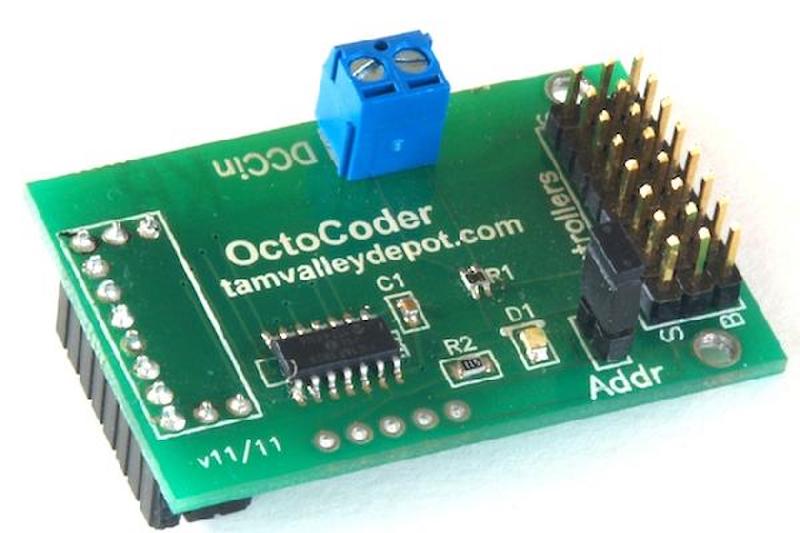
Octocoder - Stationary DCC decoder Add-on for Octopus II/III
You can control your Octopus II or III with the Octocoder, a simple stationary DCC decoder. The board provides connections os you can also connect fascia controllers and LEDs for local control. (Will not work with toggle switches however.) No CVs to program - just put on the address jumper and issue a turnout command from your throttle to set the address block. Uses 8 consecutive DCC addresses.
$24.00 US
Country of Origin: United States

Something else you might be interested in:

 © 2026 Pacific Western Rail Systems
Train Addiction Help Line: 1 866 840 7777
© 2026 Pacific Western Rail Systems
Train Addiction Help Line: 1 866 840 7777