Train Addiction Help Line: 1.866.840.7777
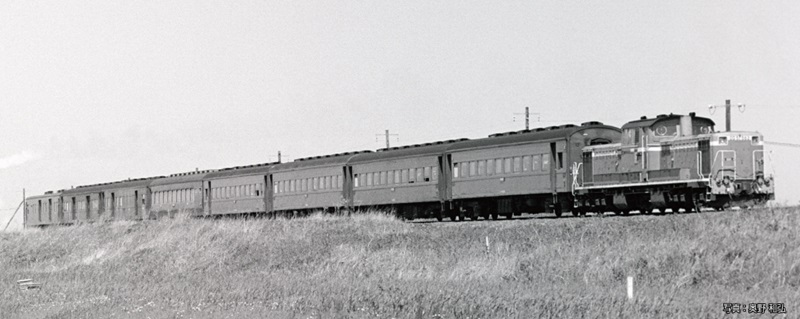
Kato (Japan) - N Scale - Night Local Train “KARAMATSU” 9-Car Set - Brown/White (SKU 3811-101880)
Available On: April 1, 2025

● Item Introduction
The “KARAMATSU” is the second in the “Night Train Series” that connects Otaru and Kushiro.
● The “Karamatsu” is a regular night train that runs 428.7 km between Otaru and Kushiro via the Hakodate Main Line and Nemuro Main Line. Although it is a regular train, it has B-sleeper cars connected to it, and these B-sleeper seats can be reserved through the Mars system for seat management and ticketing, which is why it was given the nickname “Karamatsu”. The name “Karamatsu” was discontinued with the 1980 timetable revision, making it the earliest of the nighttime slow trains to lose its name.
◆ The Mani 50 is an all-steel baggage car, of which 236 new cars were built in 1977 to replace old baggage carriages. In addition to being used in connection with various types of passenger car trains, they were converted to other uses and remained in service after the discontinuation of luggage transportation in 1986.
◆ Following the “San'in” series, KATO is pleased to announce the release of the “Karamatsu”, which was operated in Hokkaido, as the second product in the “night train” series in the KATO passenger train lineup. By replacing the “5140 Mani50” with any of the other cars in the series, it is possible to recreate a train configuration that was seen in the final years of the series.
The price list and JAN code for Mani 50 will be changed starting with this product. Other specifications remain unchanged.
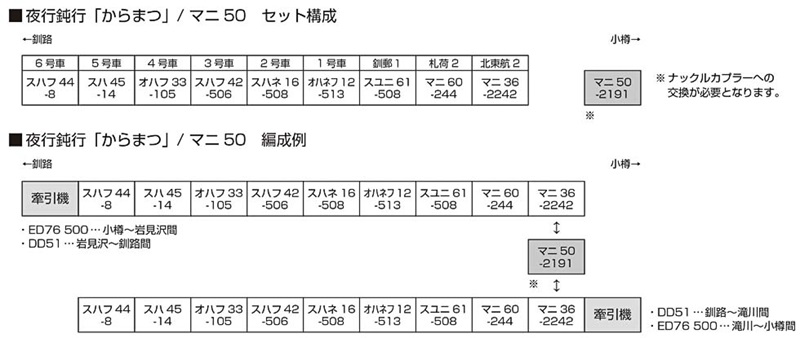
Composition of Trains

◆ Product Features
[Night Local Train “KARAMATSU” 9-Car Set]
① Kushiro freight cars (Suhane 16, Mani 60 belongs to Sapporo Operation Center, Mani 36 belongs to Sumidagawa freight car section) around 1978 are now in production.
② Mani Type 36 (modified Oha 35) and Ohafu 33 for Hokkaido are newly created. The ventilator on the roof is reproduced with separate parts.
③ Suuni-61 508 is newly created without some small windows, which differs from conventional models due to the year of production.
④ Body color: Mani 36, Mani 60, and Sui 61 are grape color No.2, and others are blue No.15. (5) Roof color: different colors are used for each car.
⑤ The locomotive coupling side of Suhafu 44 and Mani 36 are equipped with bogie-mounted Arnold couplers, while others are equipped with KATO couplers JPB as standard. (6) The Suhafu 44 and Mani 36 come with replacement knuckle couplers and coupler adapters.
⑥ Suhafu 44 and Mani 36 have taillight lights on (with off switch)
⑦ Pre-printed with car numbering, capacity, and conversion notations
⑧ Ohanef 12 and Suhane 16 are represented by printed car No. sabot, “Karamatsu” nickname sabot, and destination sabot. Other cars are reproduced with various types of sabots to match the actual cars.
[Mani 50]
① Reproduction of the body shape similar to that of a Series 50 passenger car and the large double side doors that are unique to luggage cars.
② Equipped with (2) bogie-mounted Arnold couplers
③ Tail light illuminated (one end only, with light-off switch)
④ The markings are dated around 1978. Inspection markings on the gable end are only on the side with the taillight on.
⑤ Car No. is set as “Mani 50 2191” and affiliation is set as “Kita Sumi”.


$227.00 US
Country of Origin: Japan

Something else you might be interested in:
 © 2026 Pacific Western Rail Systems
Train Addiction Help Line: 1 866 840 7777
© 2026 Pacific Western Rail Systems
Train Addiction Help Line: 1 866 840 7777